

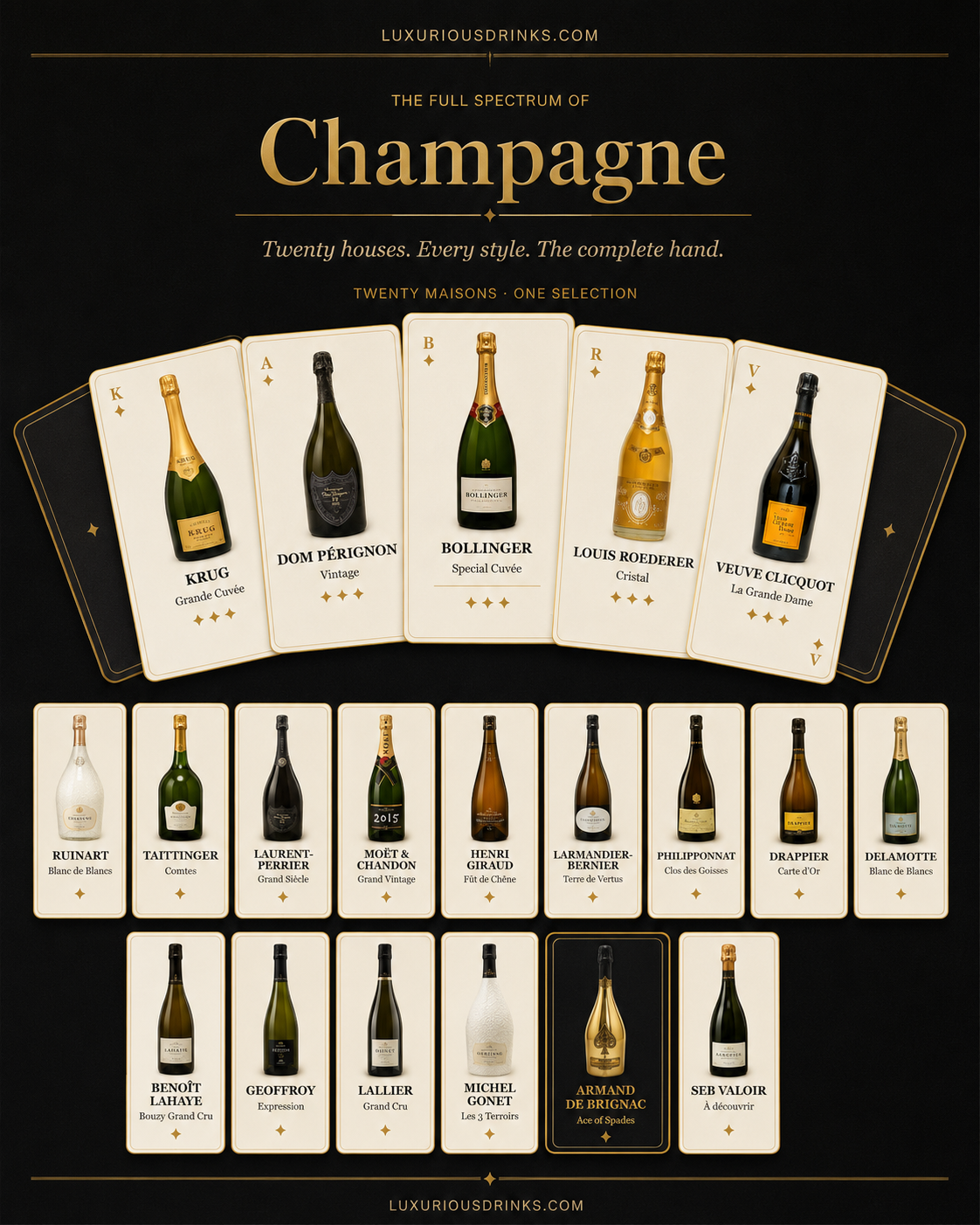
The Full Spectrum of Champagne
A SOMMELIER'S PERSPECTIVE
The Full Spectrum of Champagne
From the grande maison to the vigneron's cellar — twenty houses that together tell the whole story of what a single French region can say.
There is a moment — and every serious wine lover knows it — when a glass of Champagne stops being a celebration accessory and becomes something you actually think about. The mousse, the way the bubbles sustain themselves, the tension between a wine's acidity and the depth that comes from years resting on lees underground. That moment, once it arrives, changes how you drink forever.
I have spent the better part of two decades in cellars, at tables, and standing over blind flights trying to place wines I thought I knew. Champagne, more than almost anything else in the wine world, keeps surprising me. So consider this less a buying guide and more a conversation — from someone who has opened far too many bottles and still cannot quite get enough — about twenty houses that, taken together, represent the full breadth of what the region can do.
Champagne is not one wine. It is a hundred arguments about what wine should be, all happening in the same postcode.
The Houses Everyone Knows — and Why They Deserve That Reputation
There is a certain reflex among wine people to be suspicious of famous names. Big production, mass distribution, the wines must surely be diluted by commerce. With Champagne's great houses, this instinct is worth questioning.
Krug
Krug occupies a position almost entirely its own. The Grande Cuvée is a blend of over 120 wines from more than ten vintages, and what is remarkable is that it does not taste like a committee decision — it tastes like a singular, almost architectural vision of what Champagne can be. Rich, complex, unhurried. The cellars age wines far longer than they are required to, and it shows. If you have never opened a bottle and found yourself an hour later still turning it around in your glass trying to name what you are tasting, put Krug on that list.
Dom Pérignon
People sometimes dismiss Dom as a trophy wine, a label for people who want to be seen spending money. Those people have not tasted the P2 or P3 releases, wines that have rested in cellar for twelve or fifteen years before release. The vintage expression here is everything — each year the chef de cave makes one wine, and only one, and if the year is not good enough, there is simply no Dom Pérignon. That discipline, in a world of endless SKUs and extension labels, is its own kind of integrity.
Bollinger
If Krug is architecture, Bollinger is tailoring. The Special Cuvée is one of the most consistently well-made non-vintage wines on the market — toasty, full-bodied, with that slight oxidative quality from old reserve wine that makes it work brilliantly with food. The R.D. releases (recently disgorged, as the label says) are special occasions in bottle form. Pinot Noir country, Aÿ at its heart, and it tastes like it.
Louis Roederer
Roederer is the house I recommend most often to people who are starting to take Champagne seriously. The Brut Premier — now the Collection range — is benchmark non-vintage: clean, precise, a wonderful education in what good base wine and thoughtful blending actually taste like. And then Cristal is there when the occasion demands it, one of the great prestige cuvées, always beautifully balanced between richness and freshness. Roederer also farms biodynamically across a significant proportion of their estate, which says something about long-term thinking.
Veuve Clicquot
La Grande Dame deserves more reverence than it typically gets outside trade circles. The Yellow Label is everywhere, but the vintage wines and the La Grande Dame releases are serious bottles with serious cellaring potential. Clicquot's historical contribution to the technique of riddling — the process that removes sediment from bottle-fermented wine — shapes how every bottle of Champagne is made today. That is worth remembering when you pour a glass.
Ruinart
The oldest Champagne house, founded in 1729, and still producing some of the most elegant wines in Reims. The Blanc de Blancs is essential — lean, saline, all Chardonnay from the Côte des Blancs, the kind of wine that makes a raw oyster seem like a completely logical pairing. The R de Ruinart is a beautifully drinkable house style, and the vintage Blanc de Blancs is a wine that serious collectors should be putting away.
Taittinger
Comtes de Champagne. That is really what I want to say about Taittinger. A hundred percent grand cru Chardonnay, released only in the best years, this is one of the most graceful wines produced anywhere in Champagne. Floral, precise, with a mid-palate weight that develops into something extraordinary with a decade in a good cellar. Taittinger also remain family-owned, which in an era of conglomerate acquisitions is worth noting.
Laurent-Perrier
Two wines define this house for me: the Grand Siècle, their prestige multi-vintage blend that is deliberately built for the table rather than the apéritif, and the Blanc de Blancs, which sits somewhere between Ruinart's austerity and Taittinger's softness. The Cuvée Rosé in its distinctive bottle has a following among serious rosé drinkers, and rightly so — it is made by skin maceration of Pinot Noir, an unusual method that gives it genuine depth beyond simple fruit.
Moët & Chandon
Volume and quality are not automatically enemies. Moët produces more wine than almost anyone, and the Brut Impérial is a reliable, honest glass of Champagne at a price point that makes the category accessible. The Grand Vintage is where things get more interesting — a wine that genuinely expresses its year, with the resources of one of the region's largest estate holdings behind it. And the Rosé Grand Vintage is frequently underrated.
Small Estates, Enormous Personality — The Grower Movement
The récoltant-manipulant — the grower who farms their own vines and makes their own wine — has transformed how the world thinks about Champagne over the past twenty years. These are wines of place in a way that blended-region wines simply cannot be. Terroir, that much-abused word, actually means something here: you can taste the chalk, the particular slope, the specific village. If you have not explored this side of Champagne, everything below is an invitation.
Henri Giraud Aÿ Grand Cru · Oak & Terroir Aged in small Argonne oak barrels — unusual for Champagne — Giraud's wines have a richness and texture unlike almost anything else in the region. The Fût de Chêne is a wine that challenges preconceptions about what Champagne can taste like. For Burgundy lovers crossing over, this is a natural entry point. | Larmandier-Bernier Vertus Premier Cru · Biodynamic Pierre Larmandier is one of the great thinkers of his generation in the region. Low-dosage, biodynamic farming, wines that taste of the Côte des Blancs chalk more directly than almost anything else I know. The Terre de Vertus is a benchmark: saline, tense, extraordinarily precise. |
Benoît Lahaye Bouzy Grand Cru · Natural Sensibility Working in Bouzy, the Pinot Noir heartland, Lahaye produces wines that have a depth and earthiness unusual in Champagne. The non-dosé releases are striking — wines that survive without added sugar because the base wine is good enough not to need it. | Philipponnat Mareuil-sur-Aÿ · Single Vineyard The Clos des Goisses is one of Champagne's few genuinely famous single-vineyard wines — a steep south-facing slope above the Marne that produces grapes of extraordinary concentration. Ten years of cellar time is not unreasonable. Philipponnat also makes excellent house-style wines at far more accessible prices. |
Geoffroy Cumières · Marne Valley Pinot René Geoffroy, now joined by his son Guillaume, makes wines of real personality from Cumières. Parcellaire philosophy — treating each vineyard block separately — gives the range an educational dimension. The Expression Brut is a superb introduction. | Drappier Urville · Aube Pinot Noir Based in the Aube, the southernmost part of the appellation, Drappier are specialists in Pinot Noir-dominant wines with warmth and generosity of fruit. The Carte d'Or is consistently reliable; the vintage wines are seriously ageworthy. Drappier also pioneered very low-sulphite Champagne. |
Delamotte Le Mesnil-sur-Oger · Grand Cru Blanc Sibling house to Salon — the most exclusive Champagne on earth — Delamotte is made in the same cellars with access to some of the same Le Mesnil vineyards. The Blanc de Blancs is one of the finest wines you can buy at its price point anywhere in the world. | Lallier Aÿ · Grand Cru Focused A house with deep roots in Aÿ that has quietly built one of the most consistent ranges in the region. The Grand Cru non-vintage is made entirely from grand cru fruit, which is not something every maison can say at that price. The vintage releases age beautifully. |
Michel Gonet Mesnil-sur-Oger & Sézanne Gonet holds an extraordinary estate spanning Le Mesnil-sur-Oger and the Sézanne, giving a range that moves from chalky, tensile Blanc de Blancs to rounder, more textural expressions. The Les 3 Terroirs and single-vineyard releases repay careful attention. | Armand de Brignac Prestige · The Ace of Spades Yes, there is the cultural moment — the distinctive pewter label, the famous admirers. But behind the iconography is a wine of genuine quality: estate fruit, long ageing, serious production standards. The Brut Gold is a crowd-pleaser in the best sense. Judge the wine, not the marketing. |
Seb Valoir Artisan · To Discover Among the most exciting recent additions to any serious Champagne selection. Seb Valoir represents exactly what draws so many wine lovers to the grower movement: individuality, a direct relationship between vine and bottle, and wines that would be difficult to place in a blind tasting alongside anything else. A producer to seek out, open with curiosity, and follow closely as the range evolves. | |
The question is never really which Champagne is best. The question is which Champagne is right — for the occasion, the food, the company, and the mood you happen to be in.
How to Navigate the Range
There is a pattern across these twenty houses that is worth naming. On one side: the great maisons, with their enormous resources, their reserve wine libraries stretching back decades, their ability to maintain a consistent house style regardless of what the harvest throws at them. On the other: growers with a hectare and a vision, making wines that cannot be replicated because the vineyard is theirs alone.
These are not competing philosophies. They are complementary ones. The best Champagne cellars — whether you are a private collector or running a wine list at a two-star restaurant — contain both. A non-vintage Roederer or Bollinger for the apéritif, and a grower Champagne like Larmandier-Bernier or Benoît Lahaye when things get more serious. A bottle of vintage Dom Pérignon or Krug for the moment that demands it, and a Delamotte for a Tuesday evening when you just want to drink something excellent without ceremony.
For those beginning to explore: start with the non-vintage wines of Roederer, Bollinger, and Ruinart. They will give you the technical foundation — what good base wine, proper blending, and adequate lees ageing actually taste like. Then move sideways into the growers.
For professionals building a list: the full range here covers every occasion and every price point. The grower selections in particular offer by-the-glass options with a story attached — Larmandier-Bernier and Geoffroy especially are wines you can talk about in a way that teaches, that makes a guest more curious. The prestige cuvées give you everything you need when the table demands it.
Whatever your level of experience: these wines reward slowing down. Pour them at a proper temperature (10–12°C, not colder), in a decent tulip glass rather than a flute — the flute is better at showing bubbles than at showing wine — and take a moment before the conversation takes over. There is something in the glass that took years to arrive there. It deserves at least that much attention.
All twenty houses featured in this article are available to explore at luxuriousdrinks.com. Each listing includes full producer notes, available formats, and current vintage information.


